Two-Year Dormant Season Burn
Overview
Objectives
To demonstrate the effects of a two-year burn interval during the dormant season (November-February), on the understory community composition and pine regeneration in a pine flatwoods ecosystem.
Summary
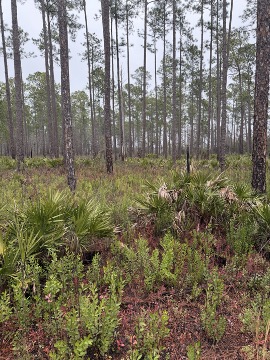
This study provides insight to the effects of a pine flatwoods ecosystem under a two-year dormant season burn. It also provides landowners the opportunity to observe the effects of this burn regime relative to a one- and three-year burn regime in adjacent stands.
The pine regeneration is more prolific here than in both the one- and three-year burn interval stands that are adjacent. This likely reflects the lower level of understory competition interacting with a burn interval that allows seedlings to establish. The stand also features relatively large gaps, and this is where most of the pine regeneration is found.
Long Description of Practice
Information not provided.
Results
Basal Area Table
| Date (month / year) | Species | ||
|---|---|---|---|
| Date (month / year) | Species | ||
|---|---|---|---|
| Date (month / year) | Species | ||
|---|---|---|---|
| Date (month / year) | Species | ||
|---|---|---|---|
Study Location / Installation Information
Lattitude
29.435891
Longitude
-82.125632
Accessibility
Landowner HAS consented to property visits WITH PERMISSION
Who installed study
First name: Scott
Last name: Sager
Year of installation
2015
Does study have end date
NO
Planned or actual end date
Information not provided.
Contact for access
Is study monumented
NO
Photos
Stand Information Pretreatment
Land Use History
Likely selectively logged, turpentined, and grazed before University acquisition in 1936.
Stand Area
15 Acres
Stand Age Before Treatment
96 Years Old
Pretreatment Overstory Community Composition
Longleaf and slash pines
Pretreatment Forest Metrics
Total Basal Area
65 Feet Squared per Acre
Species Composition
Information not provided.
Soil Series
Information not provided.
Silvicultural Application(s) Used in Study
What did the study investigate?
If silviculture included a harvest, what type(s)?
Information not provided.
Silvicultural Action(s) Timings and Types / Intensities
Information not provided.
Are there any local forest health threats to your target species?
No
Notes on silvicultural process(es) or data collection
It is important to note that there is evidence of active and inactive gopher tortoise burrows in the study unit. Gopher tortoises are a keystone species, and it is beneficial to observe and record their presence in this unit.
Plans for Future Treatments
Maintaining a two-year dormant season burn in this unit is the only treatment planned for this area
Plans for Future Measurements
The forest will be inventoried at 10-year intervals for the library.
Costs and Economic Considerations
The cost of applying prescribed fire in this stand is likely below regional costs because of an extensive road and fire break system.