Overview
Objectives
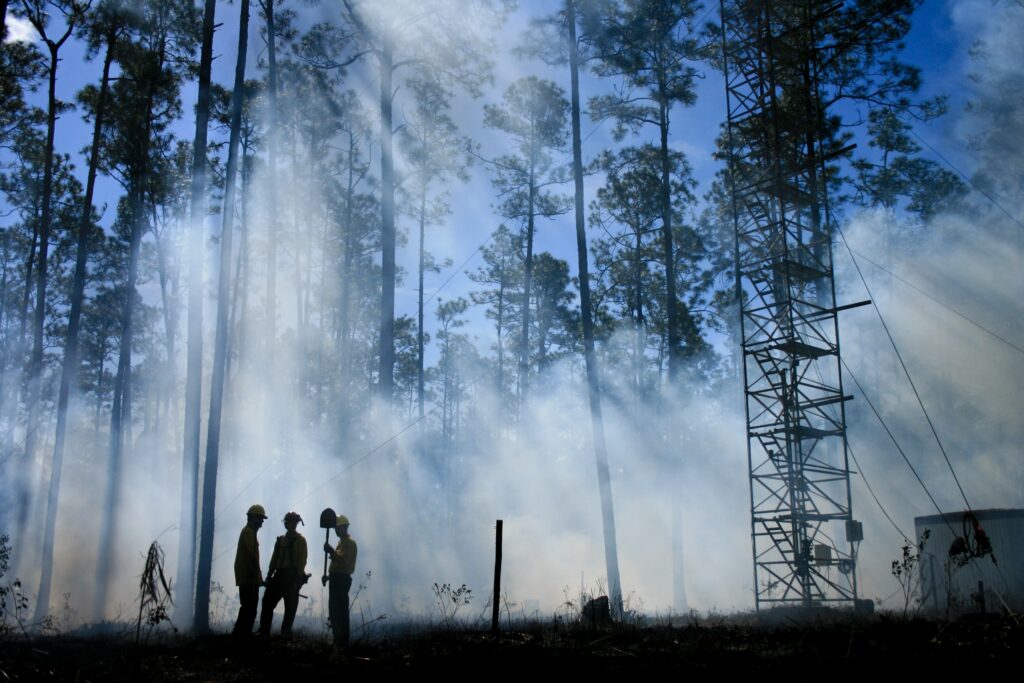
The objective of this demonstration area is to contrast the effects of fire frequency on understory species composition in a mixed longleaf (Pinus palustris) and slash pine (Pinus elliottii) flatwoods forest. Two adjacent stands feature one- and two-year burn frequencies and offer a visual contrast with this three-year burn area.
Summary
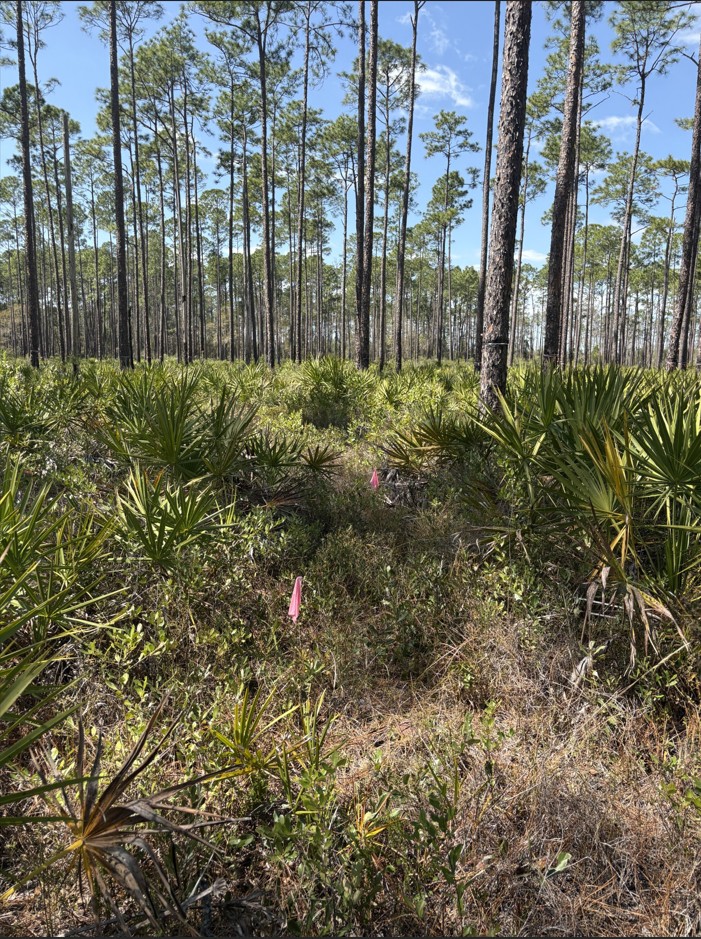
A three year burn interval leads to an understory dominated by gallberry (Ilex glabra), saw palmetto (Serona repens), and other woody shrubs. Likely because of the shrubby understory, there is very little pine regeneration. In contrast, the understory of the one-year burn interval is predominately grasses (i.e., wiregrass (Aristida stricta)), and the two year intervals has a mix of grasses and shrubs. The one-year burn has no pine regeneration, while the two-year burn intervals has pockets of pine regeneration.
Long Description of Practice
The three year burn frequency was initiated in 1998 with prior burns occurring at infrequent intervals. Early fires (<2005) often occurred during the dormant or winter season but more recent fires have been increasingly set during the late-spring and early summer (late May until mid-July).
Results
| Date (month / year) | Species / Type | ||
|---|---|---|---|
Study Location / Installation Information
Lattitude
Longitude
Accessibility
Landowner HAS consented to property visits WITH PERMISSION
Who installed study
First name: Scott
Last name: Sager
Year of installation
1998
Does study have end date
NO
Planned or actual end date
Information not provided.
Contact for access
Is study monumented
YES
Photos
Stand Information Pretreatment
Land Use History
Prior to 1936, the area was cut for timber, residual trees were worked for turpentine, and cattle grazed the area. The state acquired the site in 1936, after which the forest naturally regenerated from the residual trees, mostly longleaf pine. The stand was intermittently burned and minimally harvested for several decades, but a more concerted effort was made in 1998 to consistently burn at the three year interval. In 2016, a preparatory harvest was completed to reduce basal area to approximately ~75 ft2/ac from the previous 90 ft2/ac. In 2023, another harvest was performed to reduce basal area to 55 ft2/ac. The 2023 harvest initiated the single-tree and group tree selection experiments (also described in the library). The School of Forest, Fisheries and Geomatics Sciences, University of Florida, manages ACF as a research, education, extension, and demonstration forest.
Stand Area
104 Acres
Stand Age Before Treatment
95 Years Old
Pretreatment Overstory Community Composition
Longleaf pine and slash pine
Pretreatment Forest Metrics
Total Basal Area
78 Feet Squared per Acre
Species Composition
Information not provided.
Soil Series
Ultic Alaquods (Pomona series), deep and poorly drained; sandy texture with a spodic horizon extending from 9.8 to 35 inches (25 to 89 cm), and an argillic horizon with low permeability from 35 to 80 inches (90 to 203 cm).
Silvicultural Application(s) Used in Study
What did the study investigate?
- Prescribed Fire
If silviculture included a harvest, what type(s)?
Information not provided.
Silvicultural Action(s) Timings and Types / Intensities
Information not provided.
Are there any local forest health threats to your target species?
No
Notes on silvicultural process(es) or data collection
Plans for Future Treatments
The site will continue to receive prescribed fire on three-year intervals as a contrast for the nearby one- and two-year burn interval areas.
Additional selection harvests will likely occur between 2045-2055 depending on pine infilling and growth rates.
Plans for Future Measurements
The eddy-covariance tower will continue to measure forest carbon and water cycling.
Tree growth and understory characteristics will continue to be measured at periodic intervals by Jason Vogel and Timothy Martin. See the descriptions of the single tree and group selectin experiments in the forest.
Costs and Economic Considerations
Information not provided.