Summer Annual Prescribed Burn
Overview
Objectives
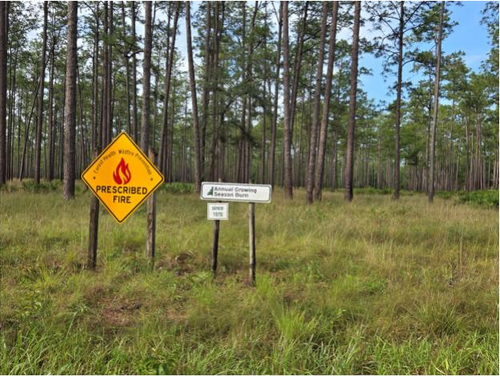
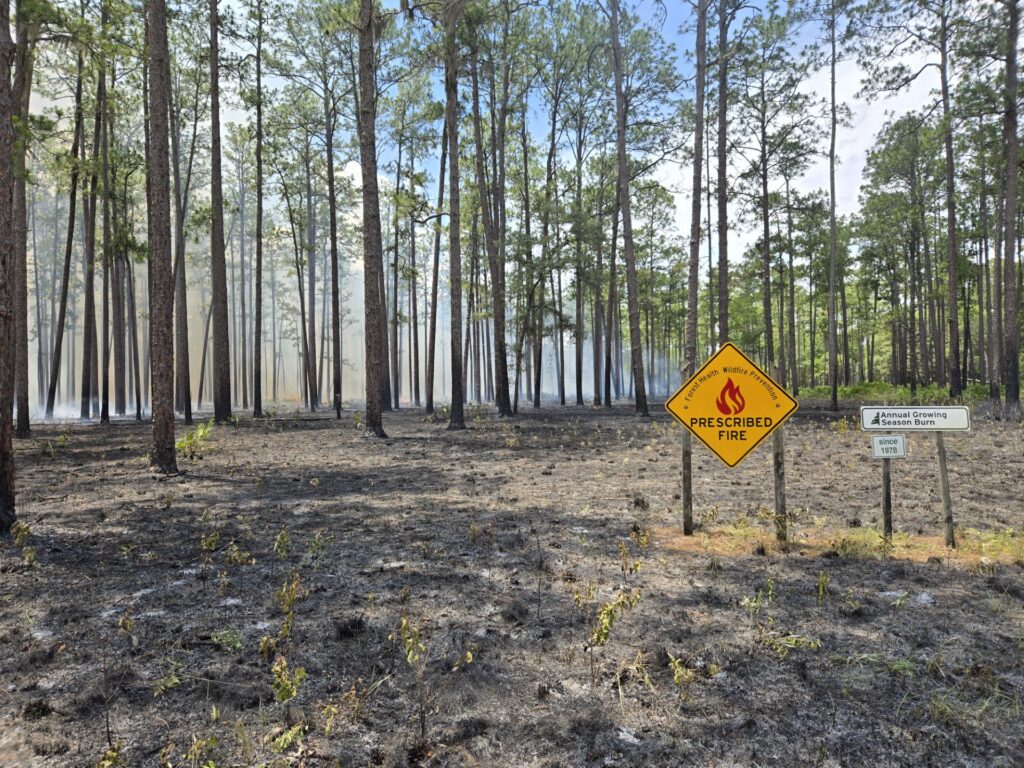
Demonstrate the effects of annual prescribed fire during the summer (approximately May-July), on the understory and regeneration of a flatwoods site.
The study area is adjacent to a flatwoods forests burned on 2- and 3-year intervals. It provides a striking visual contrast on how these burn intervals affect understory species composition.
Summary
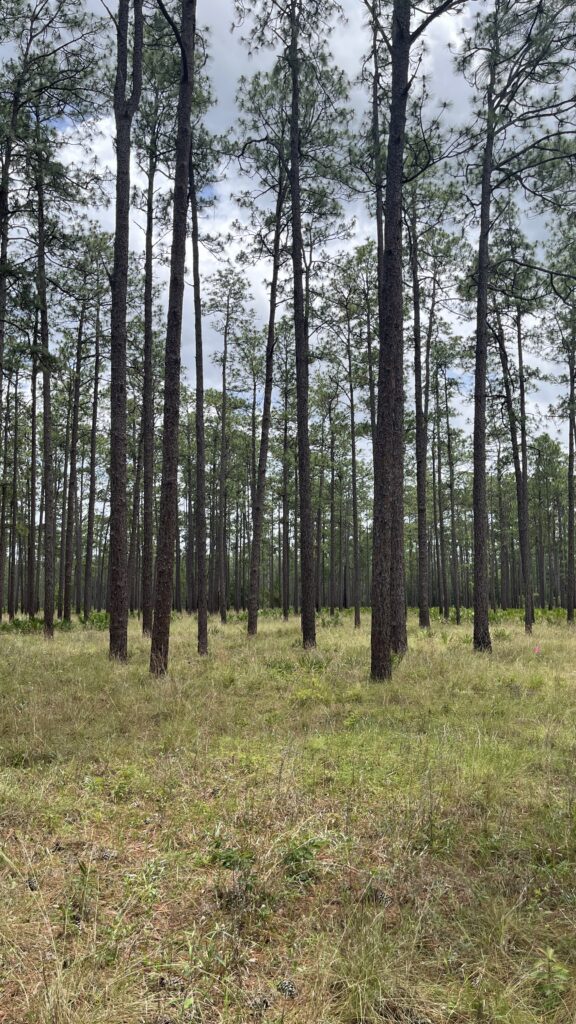
This area demonstrates how a poorly drained flatwoods pine forest can support a grass-dominated understory when frequently burned. If left unburned for several years, a host of shrub species would likely invade the area. There is no pine regeneration in this forest, likely because of the frequency of burning and the relatively high pine basal area (85.7 ft2/ac) which restricts light to the forest floor. The adjacent 2- and 3-year burn interval areas clearly show an increase in shrubs with longer time periods between prescribed burns. In contrast, the 2-year burn has significant pine regeneration concentrated in openings. There is very little natural regeneration in the 3-year burn area but an ongoing study is attempting to determine if the lack of pine regeneration was due to the previously closed canopy (it has since been harvested) or competition from the shrubby understory.
Many scientists have used this area for study. The one listed below focused on how annual prescribed burning affects understory species, primarily wiregrass. Other studies are available upon request.
Fill, J.M., and R.M. Crandall. 2024. High survival promotes bunchgrass persistence in old-growth savannas under different fire regimes. Ecosphere, DOI: 10.1002/ecs2.70092.
Long Description of Practice
Information not provided.
Results
Basal Area Table
| Date (month / year) | Species | ||
|---|---|---|---|
Tree Diameters Table
| Date (month / year) | Species | ||
|---|---|---|---|
| Date (month / year) | Species | ||
|---|---|---|---|
Study Location / Installation Information
Lattitude
Information not provided.
Longitude
Information not provided.
Accessibility
Landowner HAS consented to property visits WITH PERMISSION
Who installed study
First name: Information not provided.
Last name: Information not provided.
Year of installation
1978
Does study have end date
NO
Planned or actual end date
Information not provided.
Contact for access
Is study monumented
YES
Photos
Stand Information Pretreatment
Land Use History
Likely selectively logged, turpentined, and grazed before University acquisition in 1936. When the study was established in 1978, it was initially burned in the dormant season until 2001, when it was transitioned into the current annual summer burn regime.
Stand Area
7 Acres
Stand Age Before Treatment
43 Years Old
Pretreatment Overstory Community Composition
Mixed longleaf (Pinus palustris) and slash (Pinus elliotti) pine.
Pretreatment Forest Metrics
Total Basal Area
85.7 Feet Squared per Acre
Species Composition
Information not provided.
Soil Series
Primarily Pomona sand, which is a deep, poorly drained sandy soil typical of flatwoods. 0 to 2 percent slopes. 25 to 89 centimeters to spodic horizon.
Silvicultural Application(s) Used in Study
What did the study investigate?
If silviculture included a harvest, what type(s)?
Information not provided.
Silvicultural Action(s) Timings and Types / Intensities
Information not provided.
Are there any local forest health threats to your target species?
No
Notes on silvicultural process(es) or data collection
The stand was cruised by the SESL undergraduate crew in January 2026.
This stand has been the site of numerous individual studies that focus on different components of the ecosystem, e.g. wiregrass populations, pollinator populations, saw palmetto fruiting, understory biodiversity, etc.
Plans for Future Treatments
UF plans to continue burning this stand on an annual basis in the growing season.
Plans for Future Measurements
The area will be measured on a ~10 year interval.
Costs and Economic Considerations
Relative to other areas, this demonstration likely would have a low cost of prescribed fire because of its low fuel loads and extensive and well-maintained fire breaks. Other costs occur with fire break maintenance.