Overview
Objectives
The objective of this study is to investigate how to accelerate the development of a multi-layered forest structure in a longleaf-slash pine flatwoods stand that is even-aged with little structural diversity (i.e., different sized trees). The stand overall is being managed to transition from an even- to uneven-aged forest as would be indicated by having a diversity of tree sizes.
This entry describes a single tree selection harvest, which involves cutting individual trees throughout the forest with little development of canopy gaps.
Summary
Even-aged pine forests in the flatwoods can become "stuck" with very little development of multiple age classes. This can occur because of a high overstory basal area (too little light for seedlings), or when prescribed fire is skipped and the understory develops to the point of choking out pine regeneration. Landowners wishing to accelerate the development of multiple age class may decide to harvest, underplant, or apply herbicide. Increasing prescribed fire frequency is also an option but we maintained the three year burn interval. The purpose of this research is to determine the best path to a multi-aged or structured stand.
The single-tree selection will be compared to the group tree selection (full tree removal in small groups, also described in the library). The herbicide treatments will be compared to non-herbicide treatments and across harvest types. We provide preliminary data on planted tree survival but the study is too 'young' for the results to be considered definitive.
Long Description of Practice
A thinning was performed in 2016 to reduce basal area from ~90 ft2/ac down ~70 ft2/ac. Thinning occurred across all size classes and the two pine species.
In the spring of 2023, the single tree and group selection harvests were added with no species level discrimination in the single tree selection area. The basal area was reduced from 70 ft2/ac to ~55 ft2/ac.
In December of 2024, backpack sprayers were used to apply 32 oz chopper gen 2 (24 oz/ acre ) (imazypyr), 20 oz garlon xrt (triclopyr), 4 oz Escort (metsulfuron methyl), 3 qts mso w/ leci tech (herbicide adjuvant), and 1 qt / 100 gal weather master (surfactant) to half of the plots.
In late February / early March 2025, containerized longleaf pine seedlings (Florida Forest Service, Andrews Nursery) were hand planted in a 9' x 9' grid that extended 190' north-south and 95' east-west. The planted areas was 1/2 off a plot and the other 1/2 was unplanted.
Results
Trees per Acre Table
| Date (month / year) | Species | Survival in year 1 Single tree-no herbicide | Survival in year 1 Single tree-herbicide |
|---|---|---|---|
| 2/2026 | Longleaf pine (planted) | 86% | 89% |
Study Location / Installation Information
Lattitude
Longitude
Accessibility
Landowner HAS consented to property visits WITH PERMISSION
Who installed study
First name: Jason
Last name: Vogel
Year of installation
2023
Does study have end date
YES
Planned or actual end date
04/2100
Contact for access
Is study monumented
YES
Photos
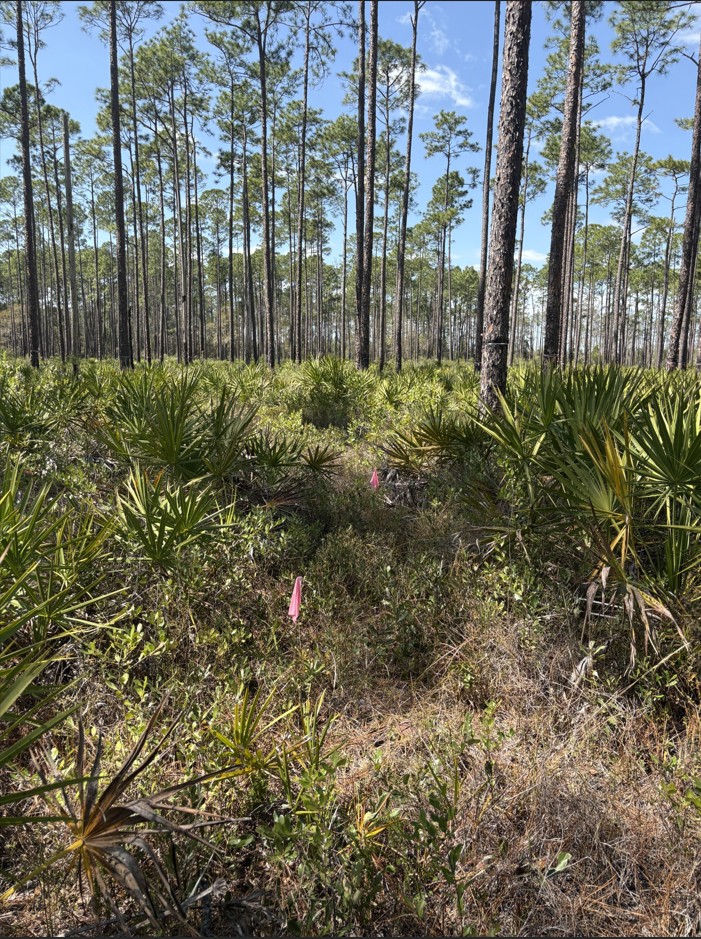
Stand Information Pretreatment
Land Use History
Likely selectively logged, turpentined, and grazed before University acquisition in 1936. The stand is even-aged, likely developing during this 1930s-1940s period of fire and grazing. A three-year prescribed burn cycle was initiated in 1999.
Stand Area
57 Acres
Stand Age Before Treatment
95 Years Old
Pretreatment Overstory Community Composition
Longleaf and slash pine.
Pretreatment Forest Metrics
Total Basal Area
90 Feet Squared per Acre
Species Composition
Species |
Average Diameter |
Percentage of Area |
Trees per Acre |
| Longleaf pine | 11.2 Inches | 70% | Information not provided. |
| Slash pine | 11.1 Inches | 30% | Information not provided. |
Soil Series
Primarily Pomona sand, which is a deep, poorly drained sandy soil typical of flatwoods. 0 to 2 percent slopes. 25 to 89 centimeters to spodic horizon.
Silvicultural Application(s) Used in Study
What did the study investigate?
- Herbicide
- Prescribed Fire
- Tree Planting
If silviculture included a harvest, what type(s)?
- Single Tree
Estimate Harvest Trees Removed
By Species
Information not provided.
Basal Area After Harvest
55 Feet Squared per Acre
Tree Density After Harvest
Information not provided.
Silvicultural Action(s) Timings and Types / Intensities
Information not provided.
Are there any local forest health threats to your target species?
No
Notes on silvicultural process(es) or data collection
Plans for Future Treatments
The next prescribed fire application is planned for summer 2027. The next harvest for this stand could occur in the 2045-2050 time period.
Plans for Future Measurements
The planted seedlings will be monitored for survival on an annual basis. Once they leave the grass stage, they will be monitored for growth.
Overstory trees will be measured and tree rings collected in 2028.
Understory biomass and species composition were measured before treatments and will be measured in 2026 and 2027.
The site is periodically flown (~1x per year) with an UAV for LiDAR and RGB measurements.
Costs and Economic Considerations
As a scientific study, we did not track costs associated with the planting or herbicide application.
Scientific Study Information
Is this study published?
No
Study Design
complete randomized design
Number of Replicates
4
Size of Plots
4 Acres
Planting Density
537 Plants per Acre